 English
 Indian
 العربية
 Español
 Deutsch
 Türkçe
 Русский
 Français (Afrique)

GTA 6: Offizielle Altersfreigabe deutet heiße Szenen an

Grand Theft Auto 6 hat endlich seine Altersfreigabe in den USA und Europa erhalten. Das nordamerikanische ESRB und die europäische PEGI haben das Spiel geprüft und kommen zu einem erwartbaren Ergebnis: GTA 6 ist ein Spiel für Erwachsene mit all den Dingen, die ihr so erwartet. Gewalt, nackte Körper, Sex, Drogen (ich zähle Alkoholkonsum mal mit dazu), Kriminalität... das volle Paket eben. Und natürlich auch Kraftausdrücke. Vermutlich genug, um das Schimpfglas nach ein paar Stunden Gameplay komplett zu füllen.
16-åring pekas ut som ledare för hackargruppen Killsec
Under torsdagen lät den spanska polisen meddela att man arresterat en person som misstänks vara ledare för Killsec, en hackargrupp som utfört en lång rad gisslanattacker under de senaste två åren. milkshakeslot.lat
Den gripne personen uppges vara en 16-åring från Rumänien och enligt nyhetsbyrån Reuters har ytterligare två personer med kopplingar till Killsec gripits i Rumänien och Storbritannien.
Tillslaget skedde i samarbete med Europol som låter meddela att man lyckats lägga vantarna på 110 terabyte data som stulits från attackerade företag och organisationer.
Star Wars: Galactic Racer review – Run-based bash racer with Burnout-style takedowns
What is it?: Arcade racing with the Star Wars sauce.
Expect to pay: $60/£50
Developer: Fuse Games
Publisher: Secret Mode
Reviewed on: Windows 11, Intel Core i9, 32GB RAM, Nvidia RTX 4060
Multiplayer?: Yes
Steam Deck: Unknown
Link: Steam
The Star Wars movies have always had a mashup quality. You take some dogfighting from The Dam Busters, some swordfighting from old samurai movies, the saloon scene from a western, and you mix 'em up real good. That's how you make one (1) Star War. There's nothing wrong with that—when The Phantom Menace threw the chariot-racing from Ben Hur into the mix, it ended up being easily one of the best parts of the movie.
While Episode 1 Racer managed to recreate that specific scene just fine, as soon as you left Tatooine the quality dropped. Star Wars: Galactic Racer sets its aim higher than recreating just one scene, and instead imagines an entire racing culture flourishing in the peacetime gap between Return of the Jedi and The Force Awakens, where crime syndicates back planet-hopping hotshots who race landspeeders, speeder bikes, and skim speeders across planets that conveniently have one biome each.
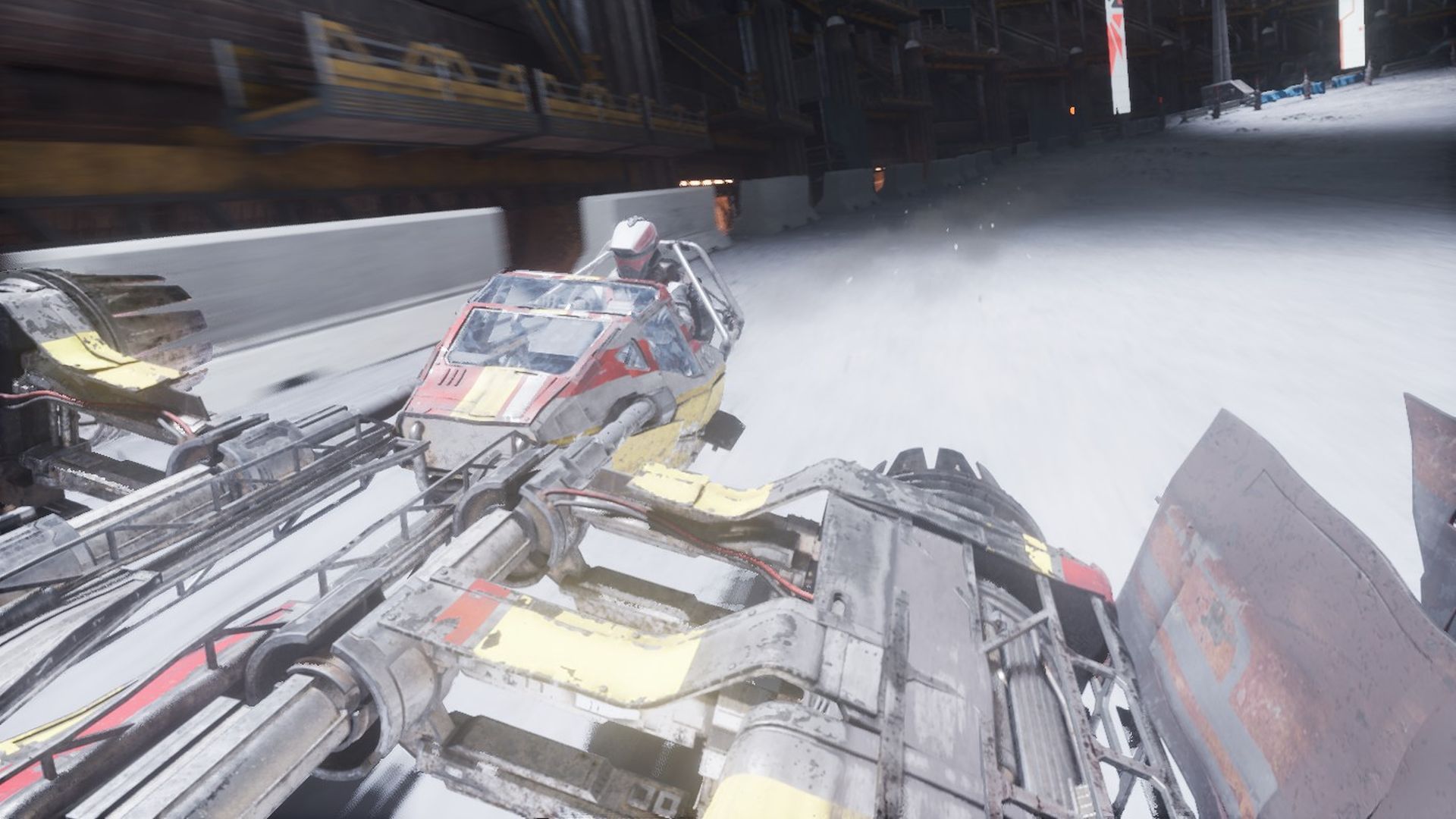
That worldbuilding helps populate a cast of rivals—the villainous Kestar Bool is immediately hateable, so well done there—including an ex-TIE Fighter pilot and a bunch of rich kids who could be real-life Formula One drivers if they weren't blue or speaking Huttese.
These characters populate the paddock you walk across every few races on your way to the upgrade monkey and they insult you during the races, though since half of those insults are in subtitled alien language I didn't pay much attention to them. If you've got time to read subtitles when you're hurling through a cavern at 450 km/h, good for you.
It's arcade racing, of course. A bit like Wipeout only instead of losing all your speed the second you touch the sides you either scrape along for a bit or bounce off or explode in a way that'll be familiar from the Burnout games. Galactic Racer studio Fuse Games was founded by a bunch of ex-Criterion developers who worked on the Burnout series as well as helping DICE with the modern Star Wars Battlefront games, so that explains that.
When you slam another racer into a wall the takedown camera pans over to give you a proper slow-motion look at their greebly Star Wars vehicle being reduced to the kind of scrap Jawas would turn their nose up at, though unlike Burnout 3 the computer isn't great at steering for you while that happens. More than once I came out of a takedown to discover the CPU was aiming me directly at a wall at high speed.
Roger Ramjet
Takedowns are a much less significant part of Galactic Racer than I expected. I thought this would, like Burnout 3, be a string of high-speed crashes with some brief bits of racing in between. Instead, it's an actual racing game—albeit one where a crocodile-faced alien will occasionally rocket into a wall and be engulfed in flame.
You've got an afterburner that gives a modest speed boost on a cooldown and a faster "ramjet" boost that can dangerously overheat if pushed to the limit, and balancing these two varieties of turbo are important. You have to pay attention to status effects like Cooled, which triggers at high speed or when cruising over water and lowers your heat, and Burning, delivered by the flame jets one opponent loves to deploy or by racing over lava, which of course raises your heat. Other status effects like Overcharged and Corroded and Shielded might factor into your build as well.
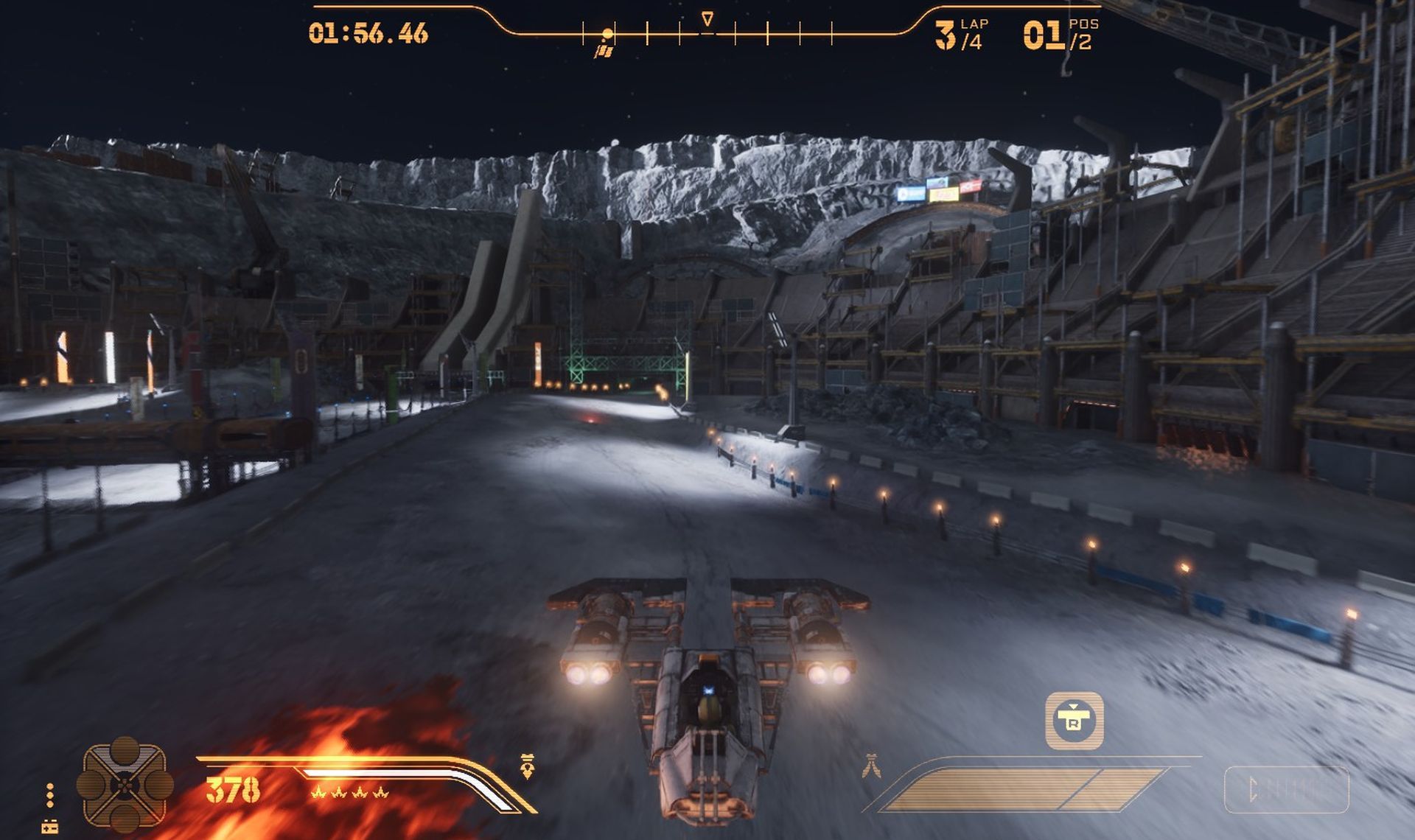
Those builds are developed over the course of a tour linking races together. Five of them in a multiplayer tour or the scenario mode where you get to play as one of the cast of rivals, or three acts worth of them in the campaign mode that borrows elements of its structure from roguelite games. This mode is run-based, so you pick your next event from a map of nodes right out of FTL or Slay the Spire, earning upgrades as you go, but if you wipe out it's back to the start of the act—with some unlocks that should make your next attempt easier.
It's not that far off the kind of knockout grand prix mode you get in other racing games, but like that crack it really is more-ish. One path might favor more traditional races, while another is high on eliminators, where you lose a league token (a life, basically) if you don't finish in the top three. But eliminators have better rewards, so I always choose them. Maybe another path has a random event or a visit to the scrap shop, which could result in some gear that radically changes my build and my odds of winning the championship. There's plenty to consider.
Death Rally
A big part of most builds are abilities. Ion bolt temporarily scrambles steering for a targeted pilot ahead of you, while the vent ability drops your heat to nothing. Concussion mine? Does exactly what it sounds like. Abilities are on cooldowns but also cost energy to use, and you've got a limited amount of that based on your battery, which is another thing that can be upgraded.
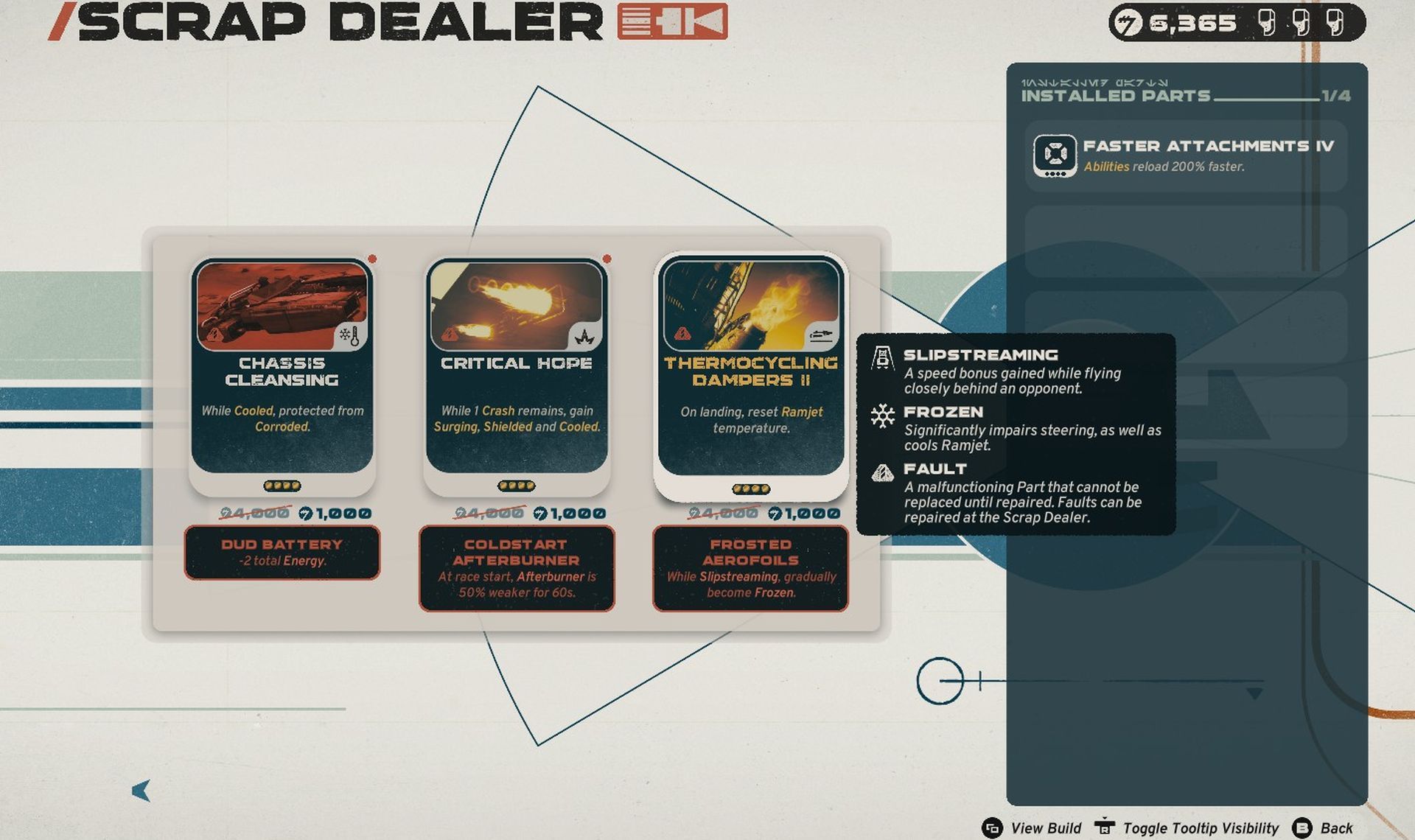
After events you get to spend whatever credits you've earned on a random selection of improvements to your racer and its abilities, as well as bolting on parts that might influence the direction your build takes—a part that refills my afterburner on collision encourages me to build for tankiness, while one that wipes all heat on a perfect landing after a jump means I can go all-in on the ramjet.
The other thing splitting up events is the paddock, a hangout for racers with a bar and garage that you walk through in third-person at the start of each planet in a tour. One of your rivals might confront you, a couple of racers may be arguing over drinks, or the league organizer might have something to say about how you're doing.
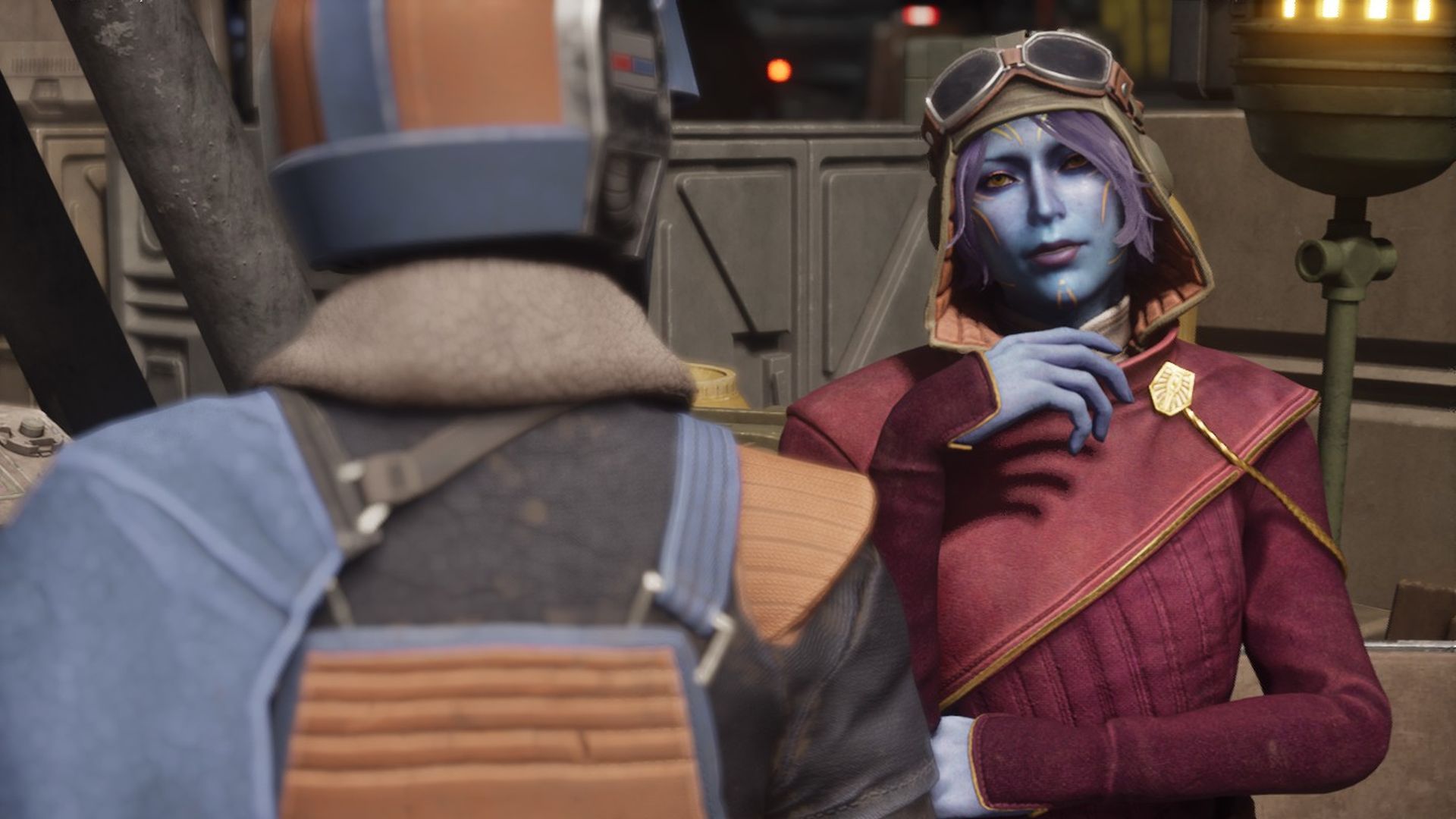
It's nothing as involved as the Underworld hub from Hades, but it does add a narrative layer and set dressing that feels properly Star Wars. The racer who dresses like an X-Wing pilot has a real 1970s mustache like Biggs (I think humans in Star Wars should always look like they're from the '70s and '80s, bring on the feathered hair and sideburns), and each planet has some native critters hanging out so they can scurry away as you approach.
Another pleasantly Star Wars touch is the pre-race check where you flip a bunch of toggles just like Han Solo sitting in the Millennium Falcon, a string of quick-time events that can give you instant access to your afterburner or power up the first activation of your abilities. Nailing a string of them feels great, though the ones that use the D-pad have reminded me why I hate the 360 controller's D-pad.
Get in the podracer, Shade
The story casts you as a human, customizable though always a helmet-wearing courier named Shade. (An anagram for Hades, now I think of it. Coincidence? Well, probably, yeah.) You get to choose from a handful of outfits and voices, then change the color swatch of those outfits and put different levels of mechanical echo on the voices.
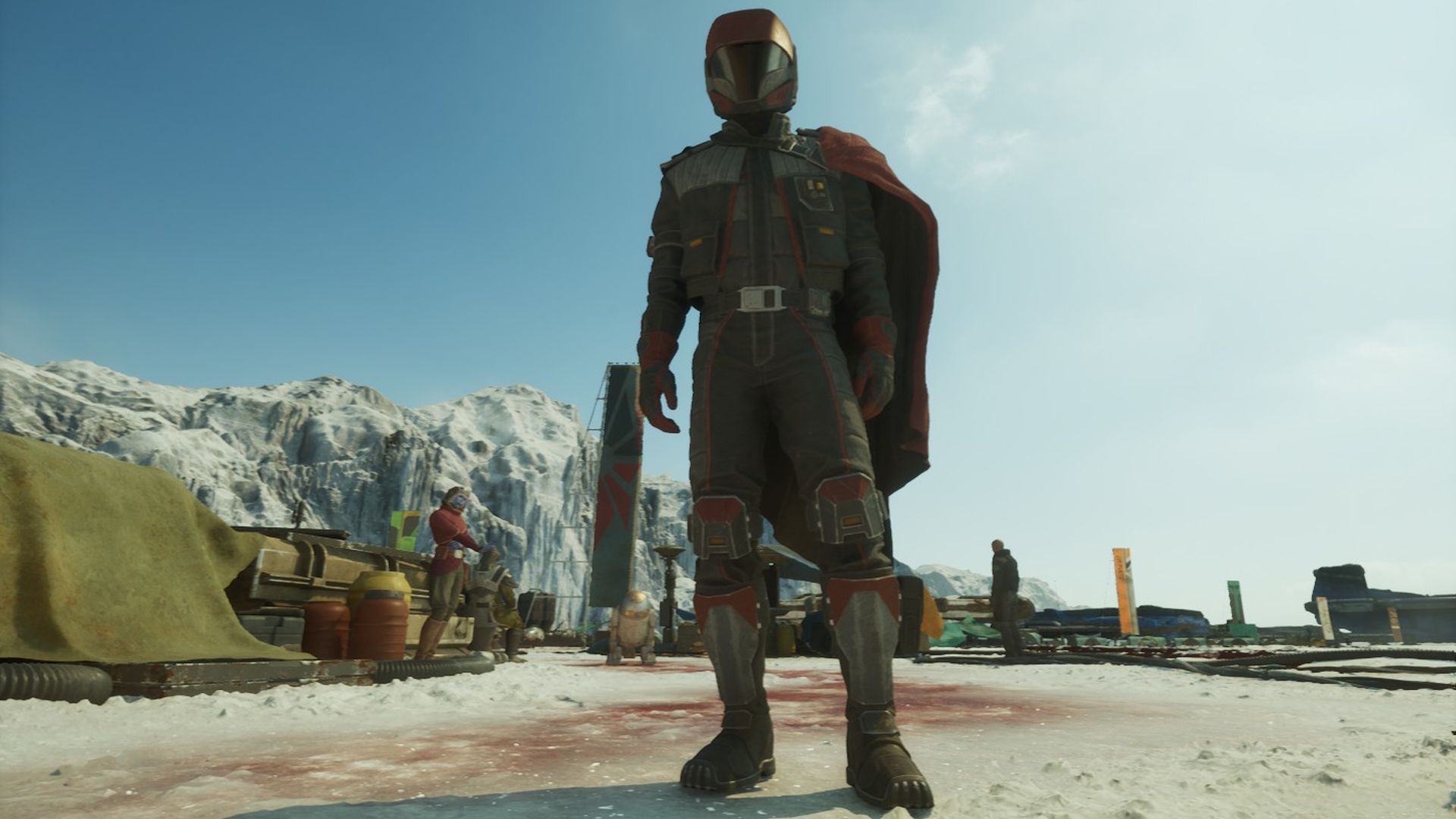
Most humans don't have the fast reaction times needed to fly a podracer, but Galactic Racer finds ways to work them in regardless—including a series of flashback races where you play as Sebulba, Anakin's main opponent from The Phantom Menace. Cantankerous and bearded, he hangs around the paddock in later acts being the legend from the old days everyone's afraid of, giving out "advice" that's actually self-aggrandizement. He rules, and ends up stealing the show from the new characters Galactic Racer introduces.
The speed of podracers is almost too much for the tracks, and I got intimately familiar with the walls of the crystal caverns on Crait (the salt-covered planet from The Last Jedi) after colliding with them a bunch of times. Something Galactic Racer definitely nails is the sense of speed. When you're whipping through tunnels making turns that seem impossible then zip out into the open, redlining the ramjet as you fly down the straight, it really does capture the feeling of riding a shopping cart down a hill after a few beers—which is the closest I've ever come to racecar driving in real life.
Wacky Races
It's frustrating then how often that feeling is interrupted by crashes caused by the tracks being hard to read. If a rival like Biddy Blas takes me out with a well-timed slam that's par for the course, but a lot of my crashes came from struggling to distinguish between an outcrop of white ice and the white snow of the racetrack, or a brown boulder and the brown sand beneath it. Some corners have rows of lights strung up to highlight them, and I wish there was an option to add more of them to certain tracks.
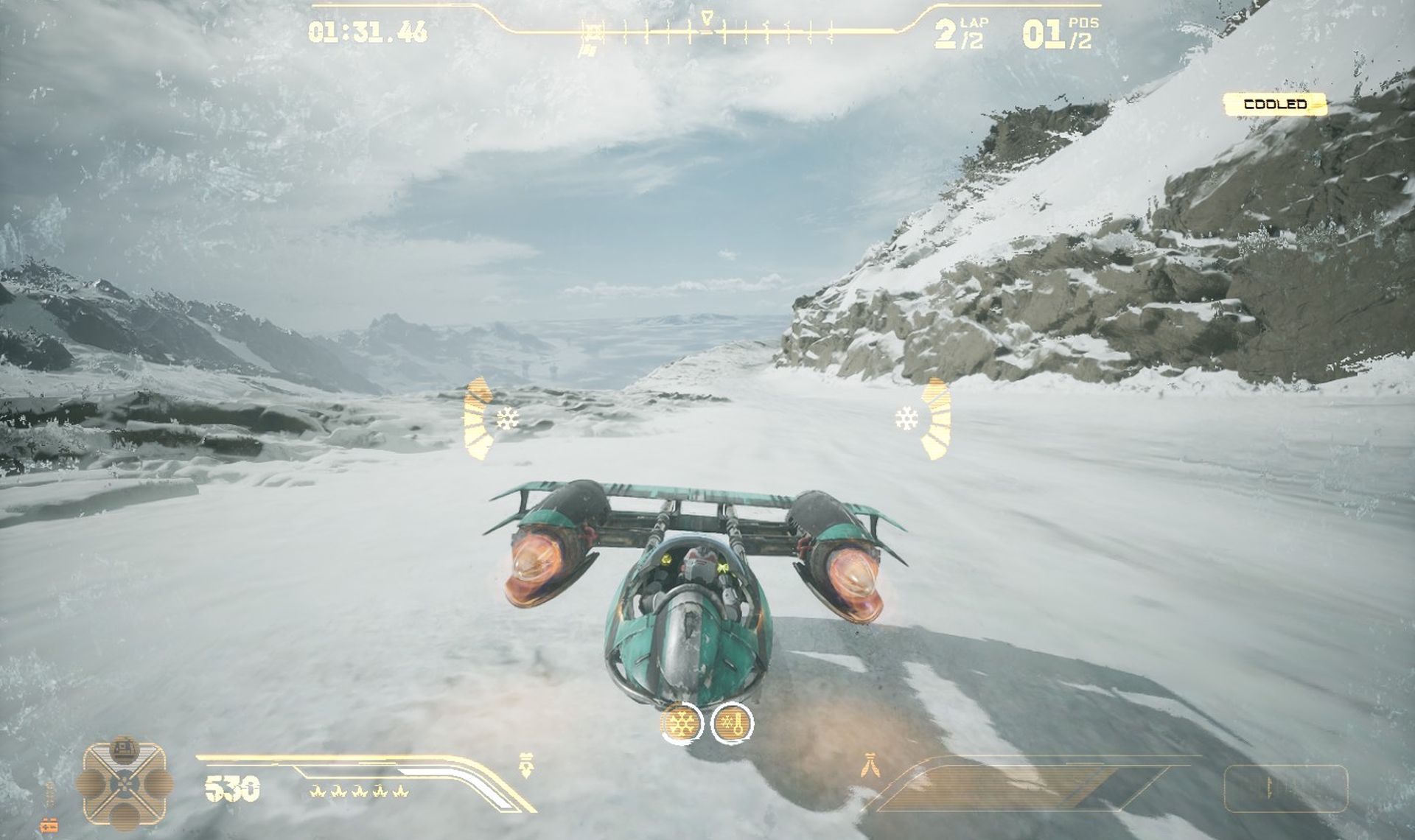
The other thing that caused more crashes than I would have liked was the autopilot ability. Activate it and you get several seconds of near-perfect piloting, with upgrades that can boost your speed and extend your ramjets while on autopilot. More than once though, I hit the autopilot and then watched in horror as it went out of its way to steer directly into the side of heating tunnels on the snow planet, or clipped the top of a tunnel after taking a jump, or drove straight over a concussion mine in the middle of the track. Even when it didn't, sometimes I'd come out of autopilot racing toward a corner at top speed, unable to slow enough to take it safely.
I kept choosing autopilot when I had the option though, because when it works it's one of the most powerful abilities in Galactic Racer. If you're struggling on the final race of act three, fully upgraded autopilot and ramjet can carry you through. It's an odd combination of overpowered and flawed, and feels like it'll probably be patched post-haste.
Revenge of the plot
The amount of story in the gutters around the races might seem odd given how badly that stuff often lands in regular racing games, but being a Star Wars game helps Galactic Racer immensely. Every generic street-racing game thinks players will care about its cast of backwards-hat douchebags and rejects from The Fast & The Furious, and we never do. Yet I enjoyed hating the hateable racers here (honestly, fuck Kestar Bool), and enjoyed slowly earning the respect of a blue lady who dresses like Amelia Earhart. The four-armed monkey mechanic who sounds like she's from Liverpool is an entertaining sidekick, and if you're the kind of fan who will recognize a character from Star Wars Resistance you'll get to point at the screen like Leonardo DiCaprio.
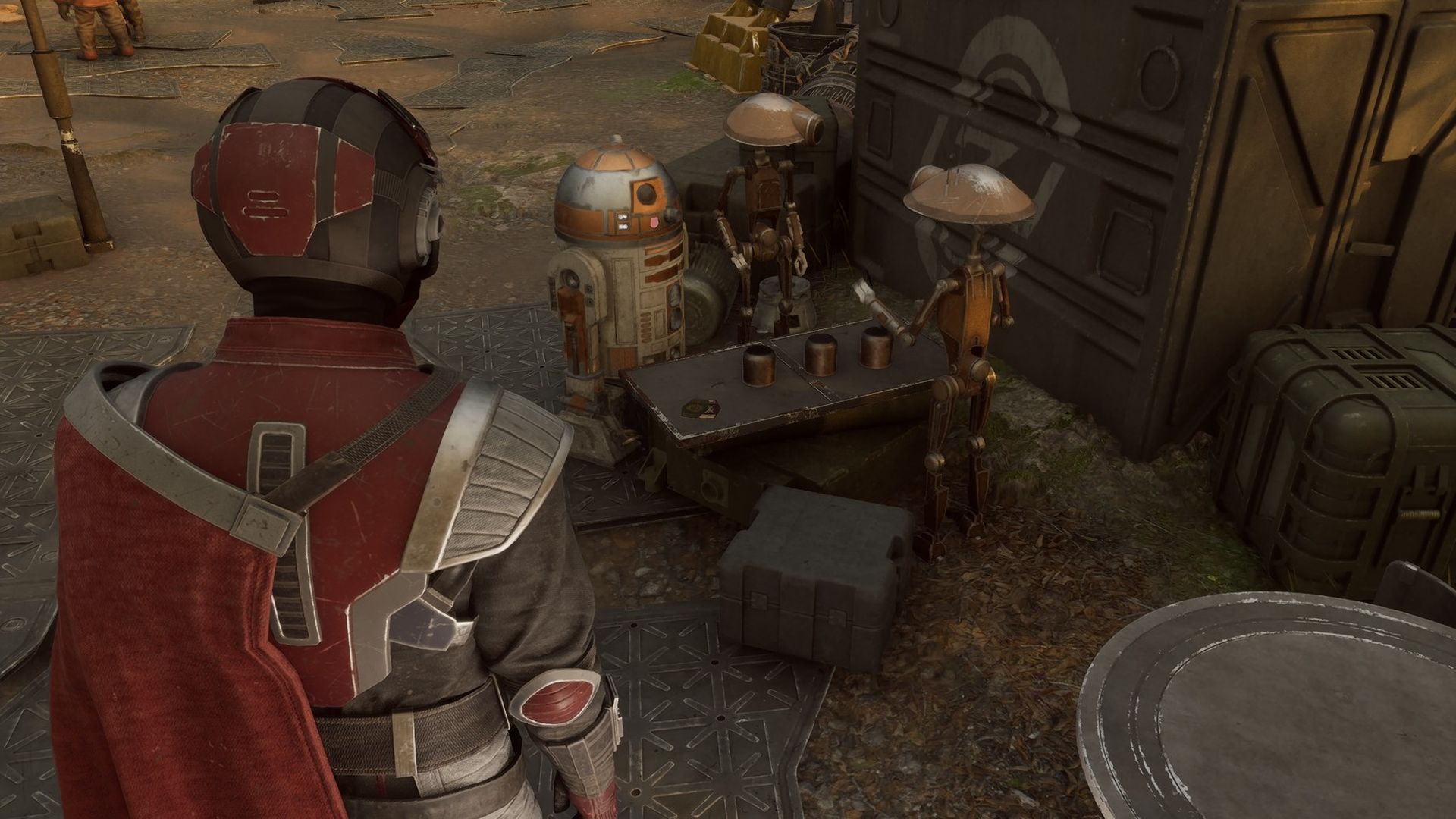
Which is why it's a shame the story doesn't amount to much in the end. When I made it to the end of act three and finally triumphed, it felt flat. There's not much payoff compared to all the setup and I feel like a rube for getting invested in the trimmings instead of the meat. Even before the finale, characters started repeating dialogue I'd already heard.
I felt kind of the same about Zero Company when I finished that. The benefit of making a Star Wars game is if you get stuff like the sound effects and the music right—Galactic Racer nails both the gnarly stutter of the engines and the soundtrack only kicking in on the final lap just like in The Phantom Menace—then you get to piggyback on the warm fuzzy feelings the movies installed in me when I was young. Even the movies struggled to pay off on the expectations that set up.
But while I didn't roll credits thinking I'd just played a masterpiece, and the signposting on some tracks wasn't great, I did enjoy zooming past Biddy Blas while he screamed "nobata nobata!" at me. Huh, maybe I did learn some Huttese after all.
My favorite PS1 creepy comedy caper now has a PC recomp, and it's thankfully not vibe coded
MediEvil, the iconic gothic PS1 platformer, is the latest classic to get the PC recompilation treatment, and I'm thrilled to confirm AI isn't involved. I'll admit that my heart initially sank given that the retro recomp scene is currently plagued with vibe-coded projects, and while the artist and voice behind Sir Dan has appropriate words for anyone who's thinking of doing that to the classic caper, this specific project is officially made with "human hands."
Highlighted by Gallowpedia, the MediEvil Recomp project by BlackLabelHQ takes the retro console classic and resurrects it with a bunch of modern tricks. The project effectively adds perks like widescreen support, scaling aspect ratio, increased draw distance/render distance, a frame rate boost, improved textures, Frame Interpolation, and elements that'll let you bring Sir Dan back on your PC with improved performance and visuals.
There's certainly room to argue over whether you should take an "of its time" gem like MediEvil and spruce it up. The platformer's visuals are a wonderful blend of PS1-specific limitations tied to draw distance and texture size and its wonderful Tim Burton-inspired art direction. That said, the fact that the project's creator outright condemns AI being used for such purposes, saying, "we value human work; PRs made with AI will be closed," means you can enjoy the revamp without destructive tech weighing on your mind.
The first beta release of the MediEvil Recomp project is out now! This lets you play MediEvil with widescreen support, scaling aspect ratio, increased draw distance/render distance, increase FPS support, PGXP, Better Terrain, Frame Interpolation, and other things all natively running on your PC.
— @medievil.wiki (@medievil.wiki.bsky.social) 2026-10-02T11:32:09.362Z
With the way things are going right now, it's extremely refreshing to see a recomp project emerge that doesn't leverage AI. Thrown-together, vibe-coded ports are swamping the internet right now, and I've already been let down multiple times this week alone. If you love MediEvil and are remotely thinking about using AI to make a PC version, though, the original game's legendary co-creator and lead designer, Jay Wilson, has an appropriate warning for you.
In response to the MediEvil Recomp and conversations about it not being vibe coded, Wilson (AKA Jay Gunn) says, "I have no idea about what this is other than what I see posted here. But I agree with what the comments are saying - keep GenAI the fuck away from MediEvil… now and in the future! The charm of those days of dev’ was that everything was handmade with barely any premade tools or shortcuts."
I naturally wholeheartedly agree with Jay's take here and the fact that its '90s limitations are what make it special. I routinely still play the first romp and its underappreciated sequel, MediEvil 2, on original hardware, and while I normally even stick to a CRT, you can absolutely use OG hardware to revisit the classic in time for the spooky season.
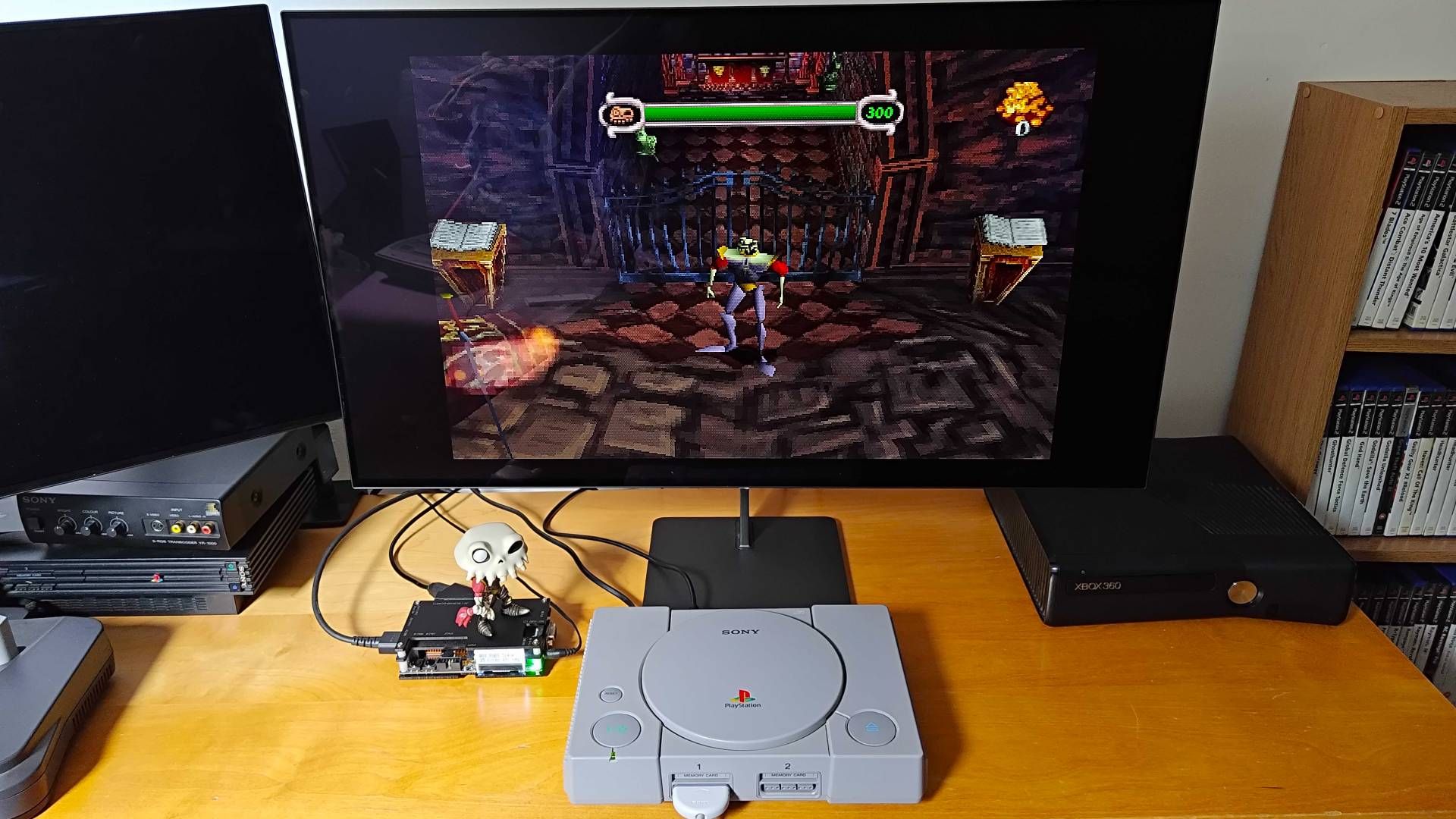
If you're looking to replay MediEvil this Halloween, I've got you covered on how to connect retro consoles to modern TVs and monitors. If you invest in an upscaler like the OSSC for $111.99 or even the GBS-C for $89.90 you'll be able to experience the platformer on your new display while maintaining the original visuals. You don't even need to stick with an OG PlayStation system specifically; if you've been looking into how to play PS2 games, you'll be able to take the same approach to play the older PS1 disc.
On the emulation front, you can also play your backup on a retro handheld if you'd rather take Sir Dan on a trip outside. Circling back to the Recomp project, you could even play it on swanky handhelds like the ROG Xbox Ally X or Steam Deck OLED if you want to embrace fancy frills like widescreen support. Ultimately, the takeaway is this: if you fancy playing MediEvil this October, try to avoid any AI-related projects that may creep out of the ground.
Swing by the best retro controllers for authentic feeling gamepads with modern tricks.
Isack Hadjar scherzt: Neuen Vertrag und Monaco-Podium "auf der Couch geholt"
Denn der Franzose mit algerischen Wurzeln bekam während seiner Zwangspause nicht nur das ...Weiterlesen